Cash vs Accrual Accounting for Travel Agents
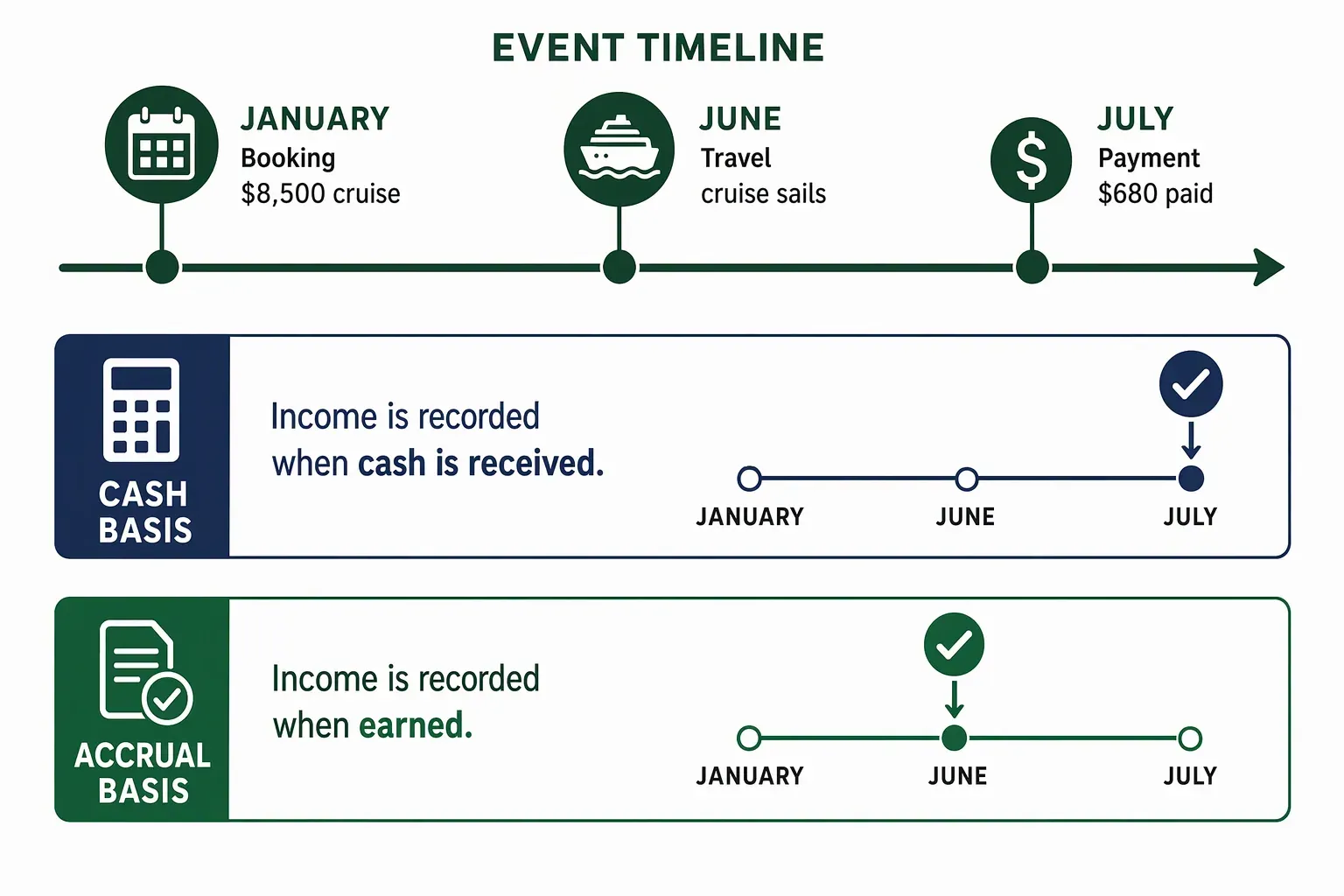
Cash basis accounting records income when you receive it and expenses when you pay them. Accrual basis records income when you earn it and expenses when you incur them. For travel agents, the difference matters because commissions are often paid weeks or months after the booking, sometimes in a different year than when you made the sale or when the client traveled. Most small travel agents start with cash basis because it's simpler and matches bank statements, then move to accrual as they grow for more accurate business reporting.
What is cash basis accounting?
Cash basis accounting follows your bank account: you record commission income the day it hits your checking account and record expenses the day you pay them. If a host agency pays you $450 on July 15, you record that income in July, regardless of when the booking was made or when the client traveled. If you pay $89 for professional liability insurance on March 3, you record that expense in March.
This method is straightforward because it matches your bank statements. You don't need to track unpaid invoices or amounts you owe. At tax time, your Schedule C income matches the deposits in your business account, minus what you paid out for deductible expenses. For agents just starting out or running a simple side business, cash basis is easier to manage without accounting software.
The downside is that cash basis can badly distort your business performance month to month. You might book $12,000 in sales in January but receive only $800 in commissions that month because most payments arrive 60 to 90 days later. Your January financial picture looks weak even though you had a strong sales month.
What is accrual basis accounting?
Accrual basis accounting records revenue when you earn it and expenses when you incur them, regardless of when money changes hands. If you book a cruise in February that travels in June, you record the commission as income in June when the travel occurs and the commission is earned, even if the host agency doesn't pay you until July. If you sign a contract for website hosting in December but the charge doesn't post until January, you record the expense in December when you incurred the obligation.
This method gives you a more accurate picture of business activity. Your February reports show the sales you made in February, matched with the expenses you incurred to generate those sales. You can see seasonal patterns clearly: which months bring strong bookings, which months are slow, how marketing spending relates to sales results.
The tradeoff is complexity. You need to track accounts receivable (commissions owed to you) and accounts payable (bills you owe). Your taxable income won't match your bank balance, so you need to plan for tax payments differently. Most agents using accrual basis rely on accounting software like QuickBooks or Xero to manage it.
The travel agent commission timing quirk
Travel agents face a unique timing mismatch that makes the accounting method choice more significant than for most service businesses. Here's a concrete example:
January 15, 2026: You book a family cruise for $8,500. Your commission will be $850 (10%).
June 10, 2026: The family sails. The cruise line confirms the booking is complete.
July 20, 2026: Your host agency pays your $850 commission split ($680 after their fees).
Cash basis: You record $680 income in July 2026 when the payment arrives. January and June show no income from this sale. If you're tracking sales goals, you can't connect this payment to the January booking without separate notes.
Accrual basis: You record $850 income in June 2026 when the cruise sails and the commission is earned. Your January sales activity connects to June revenue. You track the $680 payment in July as settling accounts receivable, not as new income.
If you book a cruise in December 2026 that sails in February 2027 and pays in March 2027, cash basis records income in 2027, while accrual records it in 2027 when the travel occurs. This can shift significant income across tax years.
Which method fits your business stage
Most independent travel agents start with cash basis and switch to accrual later. Here's who typically uses which:
Cash basis fits:
- Brand-new agents in their first year
- Part-time agents with simple operations
- Agents who prefer to do their own bookkeeping without software
- Anyone who wants their taxable income to match actual deposits
- Agents with straightforward commission arrangements from one or two host agencies
Accrual basis fits:
- Full-time agents managing complex operations
- Agents who need accurate monthly performance reports to make business decisions
- Agents paying subcontractors or managing team commissions
- Anyone whose bank balance doesn't reflect current business activity (lots of receivables outstanding)
- Agents preparing to sell the business or attract investors, who need clean financial statements
If you're currently on cash basis and finding it hard to understand your true monthly performance, or if you're constantly surprised by lumpy income months, those are signs you've outgrown cash basis.
IRS requirements and switching methods
The IRS allows most small businesses to choose either cash or accrual accounting. If your average annual gross receipts are under $25 million (which covers nearly all independent travel agents), you can use cash basis. If you maintain inventory for resale or exceed $25 million, the IRS requires accrual basis.
You pick your accounting method by checking the appropriate box on Schedule C when you file your first tax return as a business. Once you choose, you must use that method consistently from year to year. You can't switch back and forth based on which method gives a better tax result in a particular year.
If you want to change methods later, you must file Form 3115 (Application for Change in Accounting Method) with the IRS. The form requires you to calculate a one-time adjustment to prevent doubling or omitting income during the transition year. For example, if you're switching from cash to accrual and you have $6,200 in unpaid commissions at year-end, you'll report an adjustment so that income isn't lost or counted twice. Many agents hire an accountant to handle the Form 3115 filing because the adjustment calculation can be tricky.
The IRS typically approves accounting method changes for legitimate business reasons. Growing complexity and the need for better management reporting are both valid reasons to switch from cash to accrual.
The hybrid approach most agents don't know about
Here's a practical solution many established travel agents use: file your taxes on cash basis (simpler compliance and matches bank statements) but run your internal business reports on accrual basis (more accurate performance tracking).
Your accounting software can handle both. QuickBooks, Xero, and similar programs let you generate cash-basis reports for tax time and accrual-basis reports for monthly business reviews. You get the management insight from accrual accounting without the tax-filing complexity.
This approach works because the IRS cares about the method you use on your tax return, not how you organize internal reports. You file Schedule C using cash basis, matching your bank deposits and payments, but you review monthly profit-and-loss statements on accrual basis to see which months were actually strong and where your outstanding receivables stand.
The hybrid approach isn't the same as a formal "hybrid method" of accounting (which has specific IRS rules about mixing methods for different types of transactions). It's simply using accrual-basis management reports while filing taxes on cash basis. No special IRS approval required.
How to choose your method
If you're just starting as an independent travel agent, begin with cash basis. It's simpler to manage, easier to understand, and matches how most host agencies report your earnings. File your first Schedule C using cash basis and track income as you receive commission payments.
If you've been in business for a year or more and you're finding it hard to understand your monthly results because income arrives so long after bookings, consider switching to accrual. You'll get better insight into which months are productive, what your true sales pipeline looks like, and how seasonal your business really is.
If you're not sure which method you're currently using, look at your last tax return. Schedule C, Line F asks "Accounting method: (1) Cash (2) Accrual (3) Other." The box you checked tells you what you're using for tax purposes. If you can't find it or you're not sure, ask the accountant or software that prepared your return.
For most independent travel agents, the right answer is cash basis for the first year or two, then accrual basis once the business is established and you need more sophisticated financial insight. Talk to a tax professional familiar with travel agents before making the switch to make sure you handle the transition correctly.
AgentWriteOff helps independent travel agents organize trip records and expenses with practical, AI-powered tax guidance. Track bookings, log expenses, and keep commission records in one place built for how agents work.