Home Office Deduction for Travel Agents: Does Your Space Qualify?
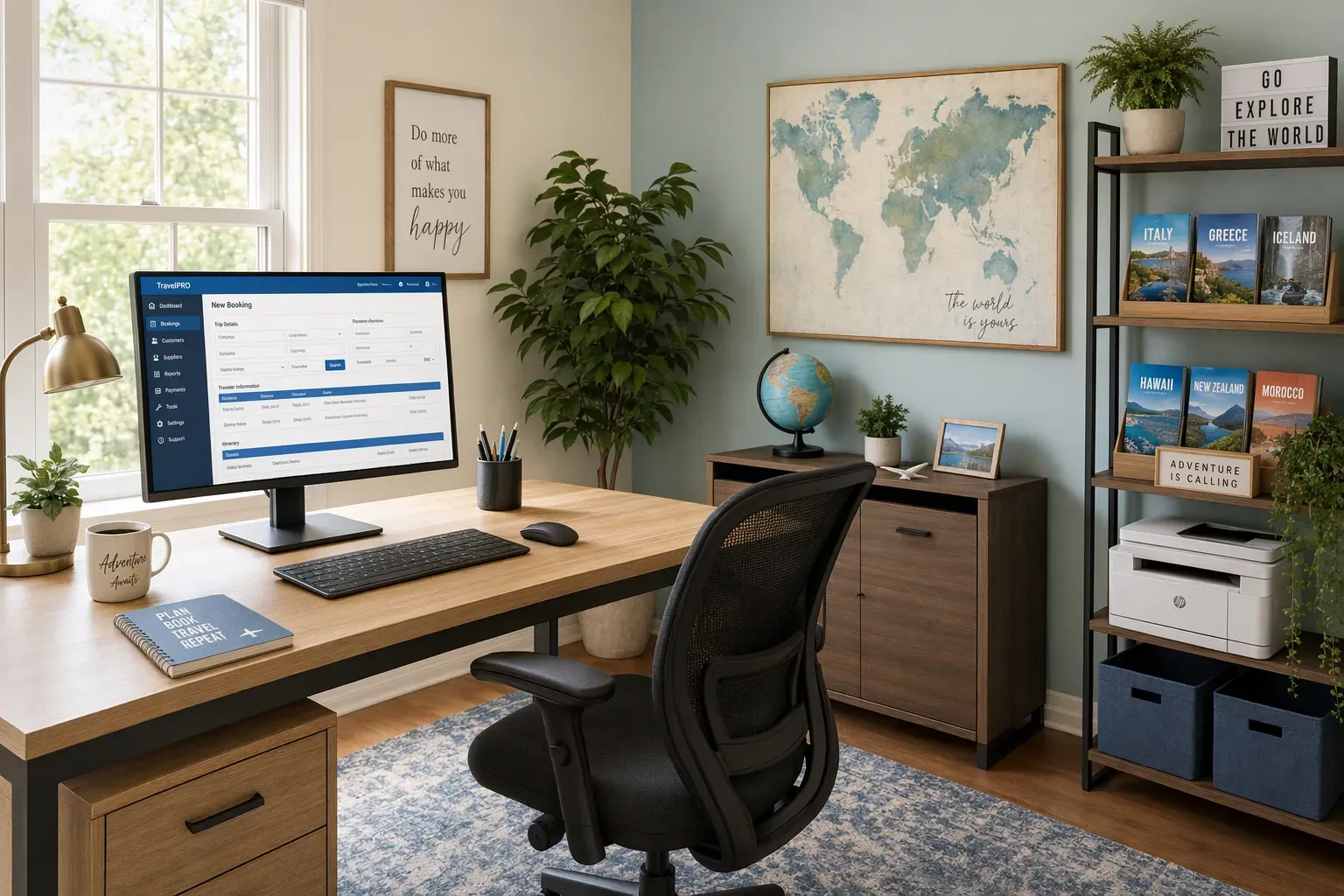
If you book trips, plan itineraries, and handle client calls from a desk in your home, that space might qualify for a tax deduction. The home office deduction lets independent travel agents write off part of their housing costs—but only if the space meets specific IRS requirements.
Here's how to tell if your workspace qualifies, what expenses you can deduct, and how to choose between the two calculation methods.
Does Your Home Office Qualify?
The IRS sets two main tests for a home office deduction: exclusive use and regular use. Both must be true.
Exclusive Use
The space you claim must be used only for your travel agent business. It doesn't need to be a whole room or have walls separating it, but you can't use that area for anything else.
Qualifies: A spare bedroom set up as an office, a converted garage workspace, or a desk and file cabinet in a corner that's never used for personal activities.
Doesn't qualify: A desk in the family room where kids do homework, a dining table where you work during the day but eat dinner at night, or a guest bedroom that doubles as your office.
The exclusive use rule is strict. If the space serves any personal purpose—even occasionally—it doesn't qualify.
Regular Use
You must use the space for business on a consistent basis throughout the year. Occasional or incidental use doesn't count.
Qualifies: You work from your home office several days a week to handle bookings, respond to client emails, plan trips, and manage your business.
Doesn't qualify: You only use the space a few times a month or during busy seasons.
Principal Place of Business
Your home office must be your principal place of business. For most independent travel agents, this means it's where you do the administrative and management work of running your business:
- Booking flights, hotels, and activities for clients
- Handling client calls and consultations
- Planning itineraries and researching destinations
- Sending invoices and tracking expenses
- Managing your calendar and client records
Even if you meet with clients occasionally at coffee shops or attend industry events elsewhere, your home office can still qualify as your principal place of business if it's where you do most of your administrative work and you don't have another fixed office location.
If you rent office space or work regularly from a supplier's location, your home office likely won't qualify under the principal place of business test.
Common Agent Scenarios
Spare Bedroom Office
You converted a spare bedroom into a dedicated office. You have a desk, file cabinet, and printer, and you only use that room for client work. This qualifies if you use it regularly and it's your principal place of business.
Corner of the Dining Room
You work at the dining table during the day, but your family eats meals there every evening. This doesn't qualify because the space isn't used exclusively for business.
Shared Guest Bedroom
You have a desk in the guest bedroom, but relatives stay there a few times a year. This doesn't qualify because the room serves a personal purpose, even if it's occasional.
Dedicated Desk in a Finished Basement
You have a workspace in your basement that's used only for business, and your family uses the rest of the basement for storage or recreation. This can qualify if the workspace area is separately identifiable and used exclusively and regularly for business.
Two Ways to Calculate Your Deduction
Once you've confirmed your space qualifies, you can choose between two methods to figure your deduction: simplified or actual expenses.
Simplified Method
The IRS lets you deduct $5 per square foot of your home office space, up to a maximum of 300 square feet.
- Maximum deduction: $1,500 per year
- Easier recordkeeping: You don't need to track every utility bill or repair receipt
- No depreciation: You won't have to deal with depreciation recapture when you sell your home
Example: Your home office measures 150 square feet. Under the simplified method, your deduction is 150 × $5 = $750.
The simplified method works well if your office is on the smaller side or if you want to avoid the extra paperwork of tracking every home expense.
Actual Expenses Method
With this method, you calculate what percentage of your home is used for business, then deduct that percentage of your actual home-related expenses.
Step 1: Measure your office space and your total home square footage.
Example: 200 sq ft office ÷ 2,000 sq ft home = 10%
Step 2: Apply that percentage to your eligible home expenses:
- Rent or mortgage interest
- Property taxes
- Utilities (electric, gas, water, trash)
- Internet and phone service (business portion)
- Homeowners or renters insurance
- Repairs and maintenance that benefit the whole home
- Depreciation (for homeowners)
Example: If your total eligible home expenses for the year are $24,000, you can deduct 10% = $2,400.
You can also deduct 100% of expenses that apply only to your office, like painting the office room or repairing a window in that space.
The actual expenses method typically gives you a larger deduction if your office is a decent size or your home costs are high. But it requires more detailed recordkeeping and uses Form 8829.
Which Method Should You Use?
- Simplified method: Best for smaller offices (under 200 sq ft) or if you want minimal paperwork
- Actual expenses method: Best for larger offices or higher home costs, and if you're comfortable tracking expenses and filing Form 8829
You can switch methods from year to year, but you can't use both in the same year.
What Records to Keep
No matter which method you choose, document your home office setup:
- Measurements: Square footage of your office and your total home
- Photos: Show the space is used exclusively for business
- Description: Note what business activities happen there (client calls, bookings, planning, invoicing)
If you use the actual expenses method, keep:
- Receipts for rent or mortgage statements
- Utility bills
- Insurance statements
- Repair and maintenance invoices
- Records of improvements and when they were made
The IRS may ask you to prove your space met the exclusive and regular use tests, so clear documentation matters.
Tracking Your Home Office Expenses
If you're using the actual expenses method, you'll need to organize your home-related costs throughout the year. Tools like AgentWriteOff can help you log expenses, categorize them, and keep the records you need for tax time—so you're not scrambling to find receipts in April.
Whether you use the simplified method or track actual expenses, keeping your workspace documentation and cost records in one place makes filing simpler and helps you support your deduction if the IRS asks.
What If You Don't Qualify?
If your workspace doesn't meet the exclusive use test—say, you work at the kitchen table—you can't claim the home office deduction. But you can still deduct other business expenses like:
- Mileage for business trips (client meetings, supplier visits, networking events)
- Business supplies and software subscriptions
- Professional development and industry memberships
- Marketing and website costs
The home office deduction is valuable when you qualify, but it's just one part of organizing your travel agent expenses. Focus on tracking what your business actually spends, and claim the deductions you're eligible for based on how you work.
The Bottom Line
The home office deduction can lower your tax bill if you meet the IRS requirements: a dedicated space used exclusively and regularly for the administrative work of your travel business.
Measure your space, choose your calculation method, and keep clear records. If your workspace qualifies, the deduction is a straightforward way to write off part of your home costs. If it doesn't, focus on the other business expenses you can track and deduct instead.