How Long to Keep Tax Records as a Travel Agent
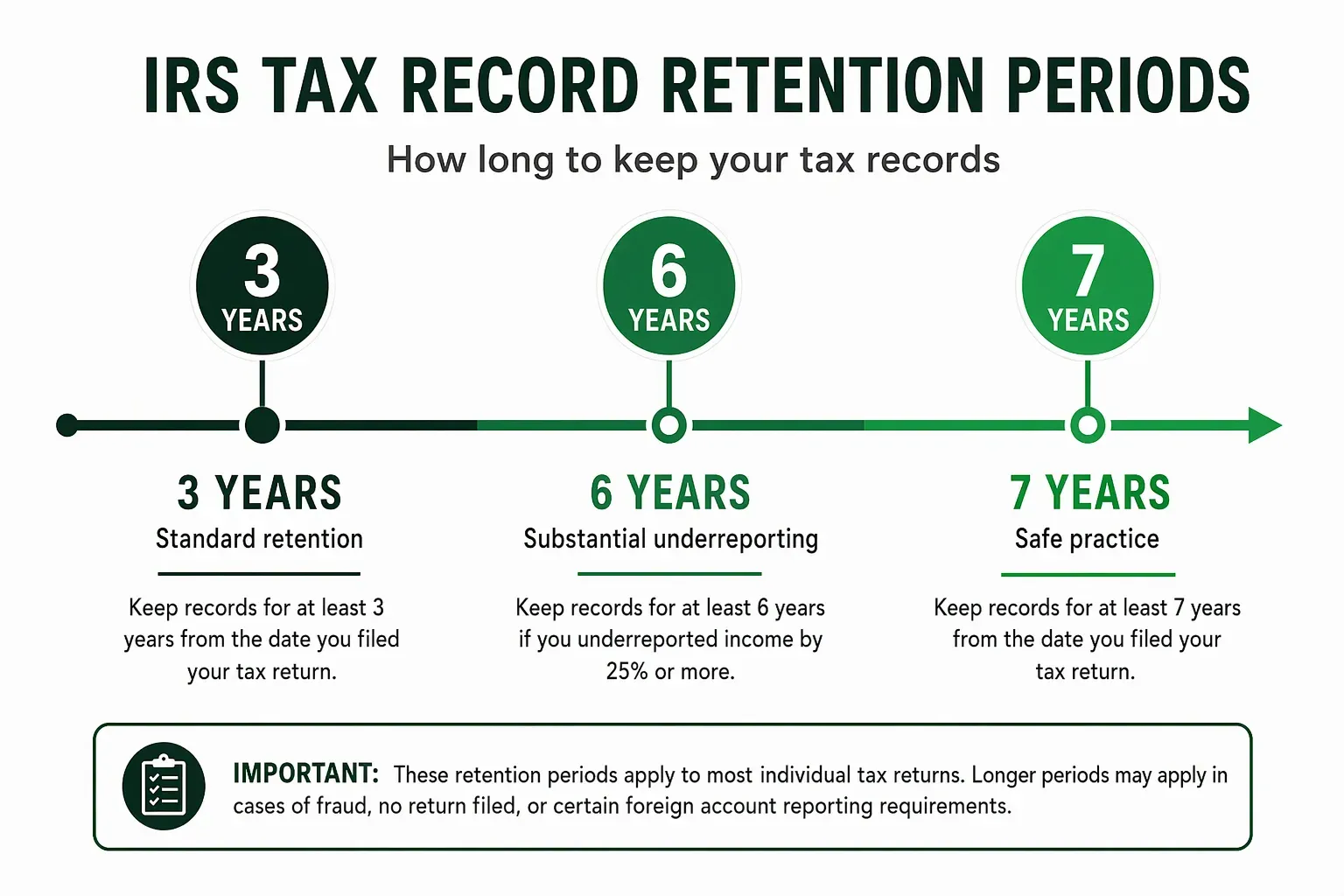
The IRS requires you to keep tax records for at least three years from when you filed your return, or the return's due date if you filed early. If you underreported income by more than 25% of your gross income, that extends to six years. For complete protection and to cover the extended audit window, most tax professionals recommend keeping all business records for seven years.
IRS Retention Requirements by Situation
The basic retention period is three years from when you filed your return or from the return's due date, whichever is later. If you file early in February for the prior tax year, the clock starts on April 15, not when you filed.
The IRS extends this to six years if you underreported gross income by more than 25%. This matters for travel agents who might receive delayed 1099 forms or miss reporting a commission that arrived late in the year. When the underreporting is substantial, the IRS has twice as long to audit.
There's no statute of limitations if you never filed a return or if the IRS suspects fraud. If you filed, reported your income honestly, and kept records, the standard periods apply.
Employment tax records follow a different schedule. If you have employees or contractors, keep those records for at least four years after the tax is due or paid.
Special Requirements for Travel Agent Expenses
Travel, meal, vehicle, and gift expenses have heightened IRS substantiation requirements under Section 274(d) of the tax code. For every deductible trip, meal, or mile, you need to document:
- The amount you spent
- The date of the expense
- The place (city for travel, name of restaurant for meals)
- The business purpose
- The business relationship (who you met with and why)
A credit card statement proves you spent money, but it doesn't prove the business purpose or who attended a meal. The IRS wants contemporaneous records—documentation made at or near the time of the expense. A receipt from March with notes written on it carries more weight than a spreadsheet reconstructed in December.
You need receipts for any expense of $75 or more. Lodging requires a receipt at any amount. Below $75, you still need a written record of the five elements above, just not necessarily a receipt.
Digital Records Are Accepted
The IRS accepts digital receipts, scanned documents, and photos of paper receipts as valid records. A photo of a restaurant receipt on your phone has the same standing as the paper original, as long as it's legible and shows the amount, date, and place.
Digital records make it easier to organize expenses by trip or category, and they don't fade the way thermal paper receipts do. If you're taking photos of receipts, back them up: a lost phone shouldn't mean lost documentation.
How Long to Keep Different Types of Records
Keep these records for at least seven years to cover the extended audit period:
- Income records: 1099 forms, commission statements, booking confirmations, host agency reports
- Expense receipts: travel, meals, conferences, FAM trips, supplies, software subscriptions
- Mileage logs: date, destination, business purpose, miles driven for each trip
- Bank and credit card statements that show business transactions
- Tax returns and supporting schedules (Schedule C, depreciation schedules)
If you deduct vehicle depreciation or claim Section 179 expensing, keep those records for the entire recovery period plus three years after you sell or dispose of the asset. For a car you deduct over five years, that means eight years from the year you bought it, or three years after you sell it, whichever is later.
If you claim a loss from worthless securities or bad debt deduction, keep those records for seven years.
The Safe Seven-Year Practice
Three years covers most situations. Six years covers substantial underreporting. Seven years covers both and gives you margin if you're not sure exactly when the clock started.
Keeping records for seven years also aligns with the lookback period for bad debt deductions and matches the retention period many accounting professionals recommend for business records generally. It's long enough that you're protected, short enough that you're not drowning in paper from a decade ago.
After seven years, unless the records relate to property you still own or depreciate, you can safely shred or delete them.
Organize as You Go
The hardest part of recordkeeping isn't the retention period—it's keeping track of everything through a busy year of bookings, trips, and client meetings. When you're logging a FAM trip in March, you need the receipt from March, not a vague memory in December.
AgentWriteOff keeps your trip records and expense details together as they happen, with AI-powered guidance on what the IRS requires for each type of deduction. It's designed around the heightened substantiation requirements travel agents face, so you're building the documentation you'll need while the trip is fresh.
If the IRS does ask questions three or six years later, you'll have the records organized and ready.