Quarterly Estimated Tax Payments for Travel Agents
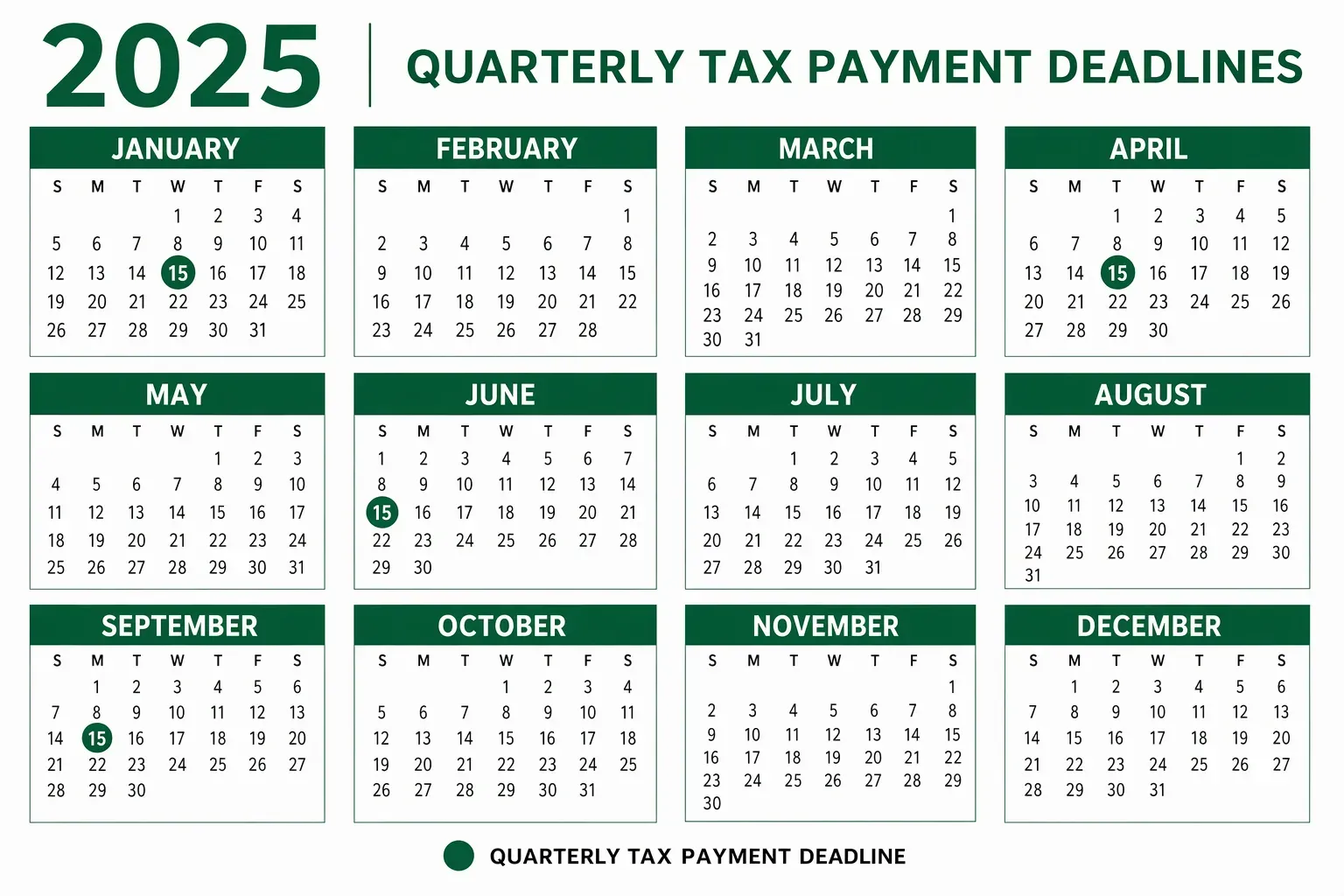
As an independent travel agent, you're responsible for paying your own taxes throughout the year because host agencies don't withhold taxes from commission checks. If you expect to owe $1,000 or more in federal tax after subtracting withholding and credits, you're required to make quarterly estimated tax payments. These payments are due four times a year—April 15, June 15, September 15, and January 15 of the following year—and cover both your income tax and self-employment tax.
When quarterly estimated payments are required
The IRS requires quarterly estimated tax payments when you expect to owe at least $1,000 in tax for the year after accounting for any withholding or credits, as explained in IRS Publication 505 and Form 1040-ES.
For most independent travel agents, this threshold is easy to reach. Here's why: host agencies pay you as an independent contractor and report your commission income on Form 1099-NEC, but they don't withhold federal income tax, Social Security, or Medicare from those payments. That means every dollar you receive is gross income, and the tax bill comes later.
If you're earning a typical commission income—say, $50,000 a year as an independent agent—you'll owe federal income tax on that amount plus self-employment tax (more on that below). Unless you have another job where taxes are withheld, or you made large estimated payments last year, you'll cross the $1,000 threshold and need to pay quarterly.
The requirement applies even in your first year as an independent agent. If you left a W-2 job mid-year and started receiving commission checks, you're still on the hook for estimated payments once your expected tax bill reaches $1,000.
There's one narrow exception: if you had no tax liability last year and you were a U.S. citizen or resident for the full twelve months, you don't have to pay estimated taxes this year. But that exception rarely applies to working travel agents.
The four quarterly payment deadlines
Quarterly estimated tax payments are due four times a year, but the periods they cover aren't equal quarters. Here are the deadlines for 2026:
- April 15, 2026: Covers income from January 1 through March 31
- June 15, 2026: Covers income from April 1 through May 31
- September 15, 2026: Covers income from June 1 through August 31
- January 15, 2027: Covers income from September 1 through December 31
If a due date falls on a weekend or federal holiday, the deadline moves to the next business day. For example, if April 15 falls on a Saturday, the payment is due the following Monday.
You can skip the January 15 payment if you file your tax return and pay the full balance by February 1. That gives you an option: make the fourth quarterly payment in mid-January, or file early and pay everything at once.
Each payment is due by the deadline regardless of when in that period you actually received the income. If you got a large commission check on March 30, that income is still covered by the April 15 payment, and you have only two weeks to account for it.
How to calculate quarterly estimated payments
There are three common ways to figure out how much to pay each quarter. You can pick the method that fits your situation, or use different methods in different years.
Safe harbor: last year's tax
The simplest method is the safe harbor rule. If you pay 100% of last year's total tax liability (110% if your adjusted gross income was over $150,000), you won't owe an underpayment penalty, even if you end up owing more when you file.
For example, say your 2025 tax return showed total tax of $12,000. Divide that by four, and you'd pay $3,000 each quarter in 2026. At tax time, if you actually owe $15,000 for 2026, you'll pay the remaining $3,000 when you file, but the IRS won't charge you a penalty for underpaying during the year.
This method works best when your income is stable or growing. If your income dropped significantly from last year, you might be overpaying, but you'll get a refund when you file.
Percentage of deposits: set aside 25-30% of each commission
Many travel agents set aside a fixed percentage of each commission check as it comes in—often 25% to 30%—then send that amount to the IRS quarterly. This method matches your tax payments to your cash flow and adjusts automatically if your income changes.
For instance, if you receive a $4,000 commission check, you'd set aside $1,000 to $1,200 in a separate savings account. When the quarterly deadline arrives, you send the total you've accumulated.
The right percentage depends on your effective tax rate. If you're in the 12% federal income tax bracket and you owe 15.3% self-employment tax on most of your income, you'll need to set aside around 25%. Higher earners may need 30% or more. A tax professional can help you estimate your rate.
This method requires discipline—you need to move money into savings every time a check arrives—but it prevents the shock of a large quarterly bill when your income was uneven.
Projected income method
The third approach is to estimate your total income for the year, calculate the tax on that amount, and divide by four. This works if your income is predictable and you can forecast what you'll earn.
Say you expect to earn $60,000 in commissions this year. After subtracting your business deductions (home office, mileage, software, etc.), you estimate $50,000 in net profit. You'd calculate your income tax and self-employment tax on that $50,000, then divide the total by four to get your quarterly payment.
The risk is that if you underestimate your income, you'll underpay and owe a penalty. If you overestimate, you'll get a refund, but your cash flow will be tighter during the year.
You can adjust your payments as the year goes on if your actual income is higher or lower than you expected. The IRS doesn't require equal payments; you just need to have paid enough by each deadline to avoid a penalty.
Self-employment tax: what surprises new agents most
Self-employment tax catches many new independent agents off guard because it doesn't exist in W-2 employment—at least not visibly.
When you work as an employee, your employer withholds 7.65% of your paycheck for Social Security and Medicare, and they pay a matching 7.65% on top of that. You never see the employer's half.
When you're self-employed, you're both the employee and the employer, so you pay both halves: 15.3% total. That breaks down to 12.4% for Social Security and 2.9% for Medicare.
For 2026, the Social Security portion applies to the first $168,600 of your net self-employment income. Income above that is only subject to the 2.9% Medicare tax. High earners with net income over $200,000 (single filers) or $250,000 (married filing jointly) also pay an additional 0.9% Medicare surtax on the excess.
Here's a worked example. Say you earn $60,000 in commissions and have $10,000 in deductible business expenses, leaving you with $50,000 in net profit. Your self-employment tax is 15.3% of 92.35% of that $50,000 (the IRS lets you deduct half of the self-employment tax before calculating it, which is where the 92.35% comes from). That works out to about $7,065 in self-employment tax.
You'll also owe federal income tax on your net profit, minus half of the self-employment tax (which you can deduct on your 1040). If you're in the 12% bracket, that's another $5,152, bringing your total federal tax to around $12,217 for the year—or about $3,054 per quarter.
That's why new agents who were used to seeing $60,000 on a W-2 and paying income tax on it are shocked to find that $60,000 in commissions triggers a much larger tax bill: they're now paying the employer's half too.
What happens if you underpay
If you don't pay enough estimated tax by each deadline, the IRS charges an underpayment penalty. It's not a flat fine; it's interest on the amount you should have paid, calculated from the due date to the date you actually paid (or filed your return).
The penalty rate changes quarterly and is based on the federal short-term rate plus 3%. For recent years, it's been in the range of 6% to 8% annually. The IRS calculates it for you on Form 2210 when you file, or you can avoid the form entirely if you paid enough to meet one of the safe harbors.
The penalty applies separately to each quarter. If you paid enough in the first two quarters but underpaid in the third, you'll owe a penalty on the third quarter's shortfall, even if you caught up by the fourth quarter.
The good news is the penalty is usually manageable—hundreds of dollars, not thousands—and it only applies when you underpaid by a significant amount. If you paid at least 90% of your current year's tax (or 100% of last year's tax under the safe harbor), you won't owe a penalty.
The bigger risk isn't the penalty; it's the cash flow hit. If you don't pay quarterly and you owe $10,000 when you file in April, that's a large bill to cover all at once. Quarterly payments spread the cost across the year.
Common mistakes travel agents make with estimated taxes
The most common mistake is not paying at all in the first year as an independent agent. Many agents who transition from W-2 employment don't realize the taxes aren't being withheld anymore. They spend the full commission check, then face a tax bill in April they can't pay.
Another mistake is using last year's W-2 income to calculate this year's safe harbor when you weren't self-employed last year. If you had a $50,000 W-2 job with $6,000 in tax withheld, paying $1,500 per quarter ($6,000 ÷ 4) won't be enough to cover this year's self-employment tax. The safe harbor only works when your circumstances are similar.
Some agents underpay because they forget to account for self-employment tax. They estimate their income tax—say, 12% of $50,000, or $6,000—and send in $1,500 per quarter. But they owe another $7,000+ in self-employment tax, so they're $7,000 short at filing time.
Others pay late because they confuse the quarterly deadlines with calendar quarters. The second payment covers April and May, not April through June, and it's due June 15, not July 15. Missing a deadline by a month can trigger a penalty.
Finally, some agents overpay because they don't subtract business deductions when estimating their tax. If you earn $60,000 but have $15,000 in deductible expenses, your taxable income is $45,000, not $60,000. Setting aside 25% of gross commissions when your effective rate on net income is lower means you're tying up cash unnecessarily.
A tool built for travel agent income and expenses
AgentWriteOff helps independent travel agents organize trip records, track expenses, and log income throughout the year, with AI-powered tax guidance built around the deductions and reporting that matter for your business. When you track commission income as it arrives, the tool can help you see what you've earned so far and estimate what you'll owe, so quarterly payments are less of a guess. Learn more at agentwriteoff.com.
Work with your tax professional
This article explains how quarterly estimated taxes work for independent travel agents, but it's not tax advice for your specific situation. Everyone's income, deductions, credits, and state tax obligations are different. Work with a CPA or enrolled agent who understands self-employment to calculate your payments, choose the right method, and make sure you're paying enough without overpaying.
Set up a simple system—a savings account where commission deposits go, a calendar reminder for the four deadlines, or a percentage you transfer every time a check clears—and quarterly payments become routine instead of stressful.