Travel Agent 1099 Reporting: Understanding Your Commission Income
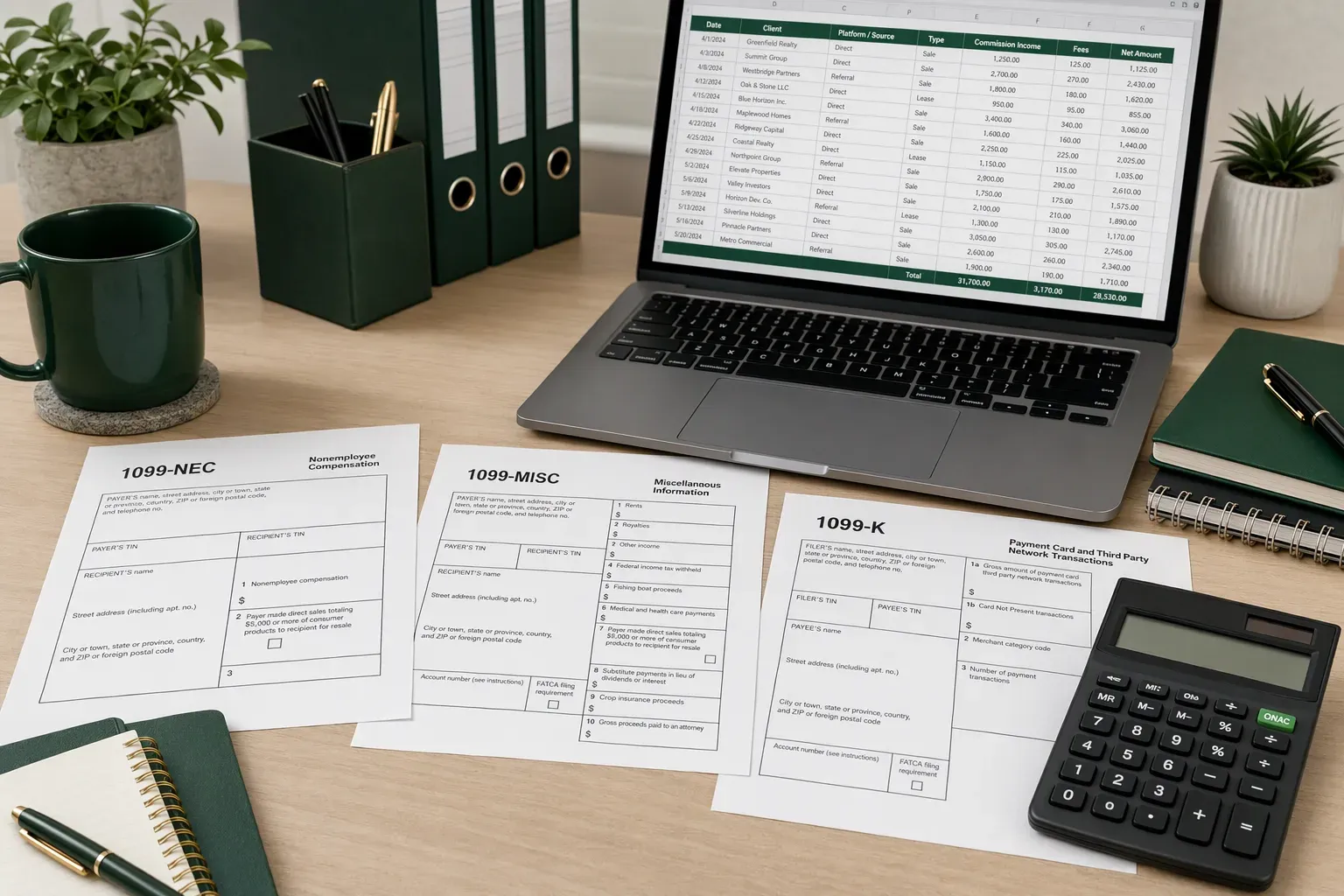
As an independent travel agent, you'll receive one or more 1099 forms each January reporting the commission income you earned the previous year. These forms come from host agencies, payment processors, and sometimes suppliers, and the IRS gets copies of every one. You're required to report all your commission income on Schedule C whether or not you receive a 1099, and mismatches between what you report and what the IRS has on file trigger automatic notices. Starting in 2026, the reporting threshold increased from $600 to $2,000 for 1099-NEC forms, which means you might receive fewer forms, but you still owe tax on every dollar you earned.
What is a 1099 form?
A 1099 form is an information return that reports income paid to you by someone who isn't your employer. The payer sends you a copy by January 31 and files another copy with the IRS. The IRS matches the amounts on these forms to the income you report on your tax return.
For independent travel agents, there are three main types of 1099 forms:
Form 1099-NEC (Nonemployee Compensation): This is what host agencies use to report commission splits. If a host agency paid you $2,000 or more in 2026 (the threshold increased from $600), they're required to send you a 1099-NEC showing that amount in Box 1. This is the most common form travel agents receive.
Form 1099-MISC (Miscellaneous Information): This form is used for certain types of payments that don't fit on the 1099-NEC. You might receive a 1099-MISC for things like prizes, awards, or royalty payments from suppliers. Box 3 reports "other income," and Box 10 reports gross proceeds paid to an attorney (which doesn't apply to most agents).
Form 1099-K (Payment Card and Third Party Network Transactions): Payment processors like PayPal, Stripe, or Square send this form if you processed more than $20,000 in payments AND had more than 200 transactions in the year. For 2026, this threshold hasn't changed, though it's scheduled to drop in future years. The 1099-K reports gross payment volume, not your net income, so it can show a much larger number than what you actually earned.
Each form serves a different purpose, and you might receive more than one for the same income. For instance, if a host agency pays you via PayPal and you cross both thresholds, you could get a 1099-NEC from the host agency and a 1099-K from PayPal reporting overlapping amounts.
The 2026 threshold change: what it means for you
Starting with payments made after December 31, 2025 (reported on 2026 tax returns filed in 2027), the threshold for Form 1099-NEC increased from $600 to $2,000.
This change means that if you worked with multiple host agencies or had a year where your commission from one agency was below $2,000, you might not receive a 1099-NEC from that payer. That doesn't mean the income is tax-free.
Here's an example. Say you earned $1,800 in commissions from Host Agency A and $3,500 from Host Agency B in 2026. Host Agency A is not required to send you a 1099-NEC because the amount is under $2,000. Host Agency B will send you a 1099-NEC showing $3,500. When you file your tax return, you must report $5,300 in commission income on Schedule C—the full amount you earned, not just the amount reported on the form you received.
The threshold change reduces paperwork for small payers, but it also increases the chance that agents will forget to report income that wasn't documented on a 1099. The IRS is clear: all income is taxable, whether or not it's reported on a form.
The old $600 threshold still applies to payments made in 2025 and earlier years. If you're filing an amended return or dealing with a prior-year notice, the thresholds in effect for that year apply.
How to reconcile 1099s with your own records
When your 1099 forms arrive in late January, the first thing to do is compare them to your own income records for the year.
Pull up your bank deposits, your host agency statements, and any tracking system you used to log commissions (a spreadsheet, accounting software, or a tool like AgentWriteOff). Add up everything you received from each payer, then check whether that total matches the amount on the 1099.
Common reasons for mismatches:
Gross vs. net commission: Some host agencies report the gross commission they received from the supplier, before splitting it with you. Others report the net amount they paid to you. If your 1099-NEC shows $10,000 but you only received $7,000 (a 70/30 split), that's a gross-vs-net mismatch. Contact the host agency to find out which method they used. If they reported gross, you can deduct the host agency's share as a commission expense on Schedule C, but you need documentation to support that deduction.
Timing differences (cash vs. accrual): Most small travel agents use cash-basis accounting, which means you report income in the year you received it. If a commission check dated December 28, 2025, didn't clear your bank account until January 2, 2026, you'd report it on your 2026 return. But the payer might have recorded it in 2025 and reported it on a 2025 1099-NEC. The reverse can happen too: a check sent in late December 2026 that you deposit in early January 2027 would be reported by the payer on a 2026 form but counted by you in 2027. These timing differences are common and can be explained if the IRS questions them.
Multiple payers for the same booking: If you're an independent contractor for more than one host agency and you split a large booking, you might receive two 1099 forms covering what you think of as a single commission. That's correct—you report the total. Just make sure you're not double-counting it in your records.
Unreported income below the old threshold: Some agents didn't report small amounts of income that came in under the old $600 threshold because they assumed it didn't need to be reported if no 1099 was issued. That was always incorrect—all income is taxable—but it became more common when agents worked with multiple hosts or had side income. Under the new $2,000 threshold, it's even easier for small amounts to fall through the cracks.
If the 1099 amount is higher than your records show, don't ignore it. Contact the payer to ask for a breakdown. If they made a mistake, they can file a corrected 1099. If the number is correct and your records were incomplete, update your records and report the correct amount.
If the 1099 is lower than what you actually received, that's unusual but possible (maybe they issued a corrected form and you didn't get it, or they combined payments across years). Report the actual amount you received. Keep your bank records and payer statements in case the IRS asks.
What to do if you get a mismatch notice from the IRS
The IRS uses an automated system to match the income reported on your tax return to the 1099 forms it received from payers. If the numbers don't match, you'll get a CP2000 notice proposing a change to your return and asking for additional tax.
A CP2000 is not a bill, and it's not an audit. It's the IRS saying, "We have a 1099 on file showing $10,000 in income, but your return only shows $7,000. Please explain the difference or pay the additional tax."
Here's what to do when you receive one:
Don't ignore it. You have 30 days to respond. If you don't respond, the IRS will assess the additional tax, plus penalties and interest, and you'll have a much harder time fixing it later.
Compare the notice to your records. The CP2000 will list the 1099 forms the IRS has on file and the amounts. Check whether those amounts match what you reported. If you reported the income on a different line of your return (say, the 1099-K amount was included in your Schedule C total but not broken out separately), you can explain that in your response.
Gather documentation. If the mismatch is because the 1099 reported gross commissions and you only received a net amount, you'll need a statement from the host agency showing the split. If it's a timing issue (income you received in a different year), you'll need bank statements showing when the payment cleared.
Respond in writing. The notice includes a response form where you can agree with the proposed change, disagree and explain why, or agree in part. If you disagree, attach copies of your documentation (don't send originals). Explain the mismatch clearly: "The 1099-NEC from Host Agency A reports $10,000 in gross commissions. I received a 70% split, or $7,000, as shown on the attached agency statement. The remaining $3,000 was retained by the host agency and is deducted as a commission expense on Schedule C, line 10."
Keep copies of everything. Mail your response via certified mail with return receipt so you have proof the IRS received it.
If the notice is correct—you did underreport income—agree with the proposed change and pay the tax. The IRS will add penalties and interest, but those are smaller if you respond quickly.
If the issue is complex or the amount is large, consider working with a CPA or enrolled agent who handles IRS notices. Many of these mismatches can be resolved with a clear explanation and proper documentation, but the process is easier with someone who knows the system.
When you must issue 1099s to sub-agents or contractors
If you pay other independent contractors or sub-agents as part of your business, you might be required to issue 1099 forms to them.
You must file a Form 1099-NEC if all of the following are true:
- You paid someone $2,000 or more during the year (the new threshold applies here too).
- You paid them for services related to your trade or business.
- You paid them as an independent contractor, not as an employee.
- The person you paid is not a corporation (with some exceptions—corporations generally don't get 1099s, but attorneys do).
Here's a common scenario: you're an independent agent and you bring on a part-time assistant or a sub-agent to help with bookings. You pay them $3,000 for the year. If they're working as an independent contractor (not on your payroll as a W-2 employee), you need to issue them a 1099-NEC by January 31 and file a copy with the IRS.
Before you pay anyone $600 or more (the IRS still uses this threshold for the requirement to collect a W-9, even though the reporting threshold is now $2,000), have them fill out Form W-9. This form collects their name, address, and taxpayer identification number (Social Security number or EIN). You'll need that information to file the 1099.
If you don't file required 1099 forms, the IRS can penalize you $60 to $310 per form, depending on how late it is. The penalty is higher if the IRS determines you intentionally disregarded the requirement.
You can file 1099 forms yourself using the IRS FIRE system (free for up to 250 forms), or you can use payroll software, your accountant, or an online service. The deadline is January 31 for giving the form to the recipient and filing it with the IRS (it used to be later for the IRS copy, but that changed in recent years).
Reporting 1099 income on Schedule C
All of your commission income—whether or not it's reported on a 1099—goes on Schedule C (Form 1040), Profit or Loss from Business. This is where self-employed individuals report their business income and expenses.
You'll report your total income on Line 1 (Gross receipts or sales). Don't break it out by which 1099 it came from; just enter the total gross commissions you received during the year. If you use cash-basis accounting (the most common method for small businesses), that's the total of all deposits and payments you received, regardless of when the booking was made or when the client traveled.
If a 1099-K reported a large amount because it included gross payment volume (not just your commission), you'll need to reconcile that on your return. The IRS is aware that 1099-K amounts often include money that passed through your account but wasn't your income (client payments that you forwarded to suppliers, refunds, chargebacks). Some tax software asks for 1099-K amounts separately and lets you subtract the non-income portions. If your software doesn't, attach a statement explaining the reconciliation.
Deductible business expenses go on the other lines of Schedule C: advertising, car and truck expenses, commissions and fees (the host agency's share, if applicable), office expenses, travel, meals (at 50%), and so on. Your net profit—the amount after expenses—is what you'll pay income tax and self-employment tax on.
The 1099 forms themselves don't get attached to your tax return. Keep them with your tax records for at least three years (or longer, as explained in IRS Topic 305).
A tool built for travel agent commission tracking
AgentWriteOff helps independent travel agents track trip records, log commission income, and organize expenses throughout the year, with AI-powered tax guidance designed around your business. When you log commissions as they arrive, you'll have accurate year-end totals to compare against your 1099 forms, so reconciliation takes minutes instead of hours. Learn more at agentwriteoff.com.
Work with your tax professional
This article explains how 1099 reporting works for independent travel agents, but it's not tax advice for your specific situation. Commission structures, host agency arrangements, payment timing, and state tax rules vary. Work with a CPA or enrolled agent who understands self-employment and travel industry income to make sure you're reporting correctly, handling mismatches properly, and taking advantage of every deduction you're entitled to.
When your 1099 forms arrive in January, don't just file them away. Compare them to your records, reconcile any differences, and reach out to payers if something looks wrong. That ten minutes of work in January can save you hours of stress and a CP2000 notice later.