Travel Agent Conference Tax Deduction: What's Deductible?
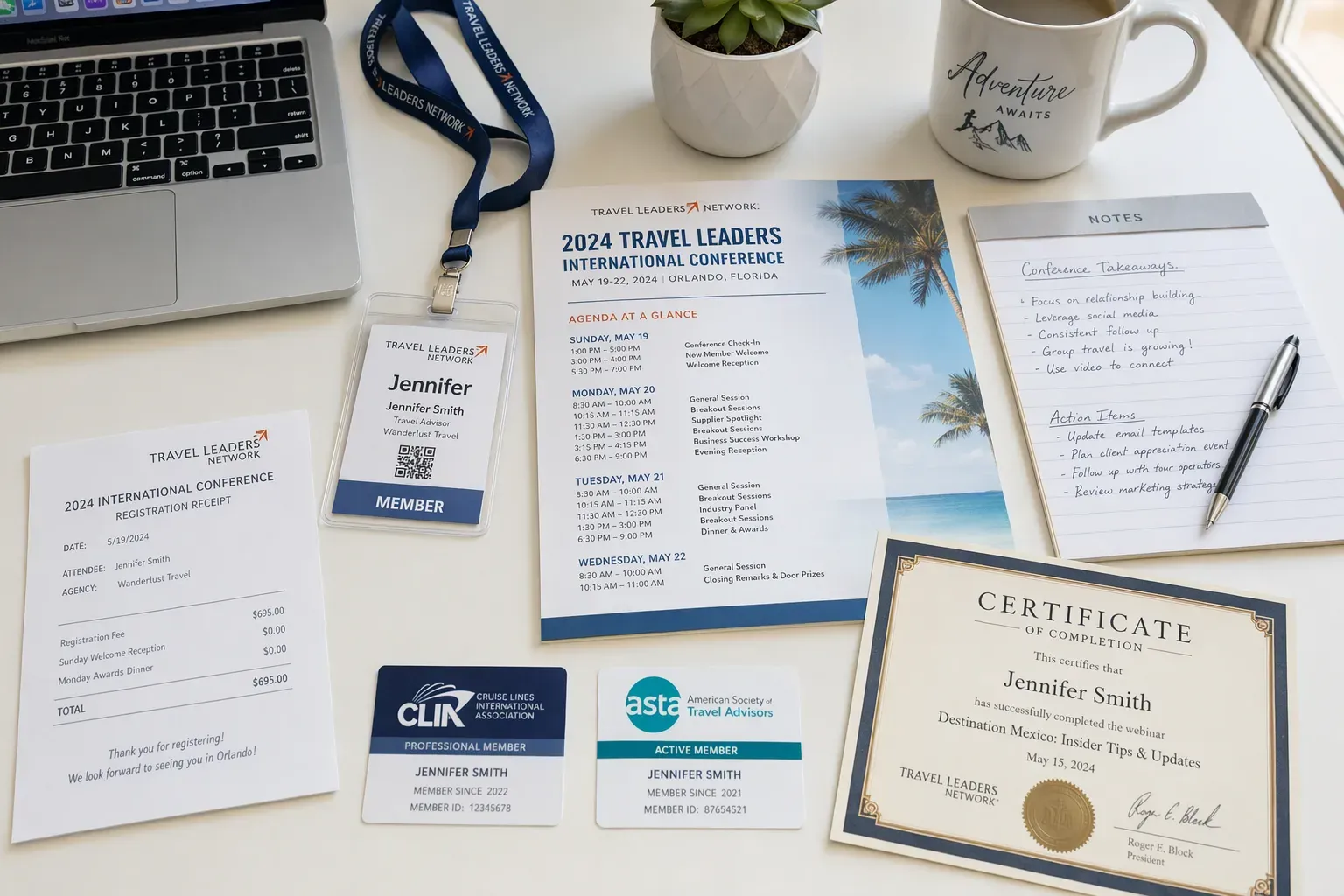
Conference registration, travel expenses, education courses, and professional memberships are tax deductible for independent travel agents when they benefit your business. Land-based conferences follow ordinary business travel rules: you can deduct registration fees, airfare, hotels, ground transportation, and 50% of meals, with no annual cap. Cruise ship conferences face stricter IRS limits—a $2,000 annual deduction cap, requirements that the vessel be U.S.-registered and visit only U.S. ports, and two signed written statements you must attach to your tax return. Education expenses like webinars, supplier training, and courses are deductible when they maintain or improve skills for your current work. Professional memberships in organizations like CLIA, ASTA, your host agency, or consortium are fully deductible.
Land-based conference deductions
If you attend an in-person travel industry conference—ASTA's Global Convention, a host agency summit, a supplier showcase, or a regional travel agent event—the costs are deductible under ordinary business travel rules when the conference benefits your business.
Here's what you can deduct:
Conference registration fees: The full cost of your ticket or registration, whether it's $200 for a one-day local event or $1,500 for a multi-day national conference.
Airfare or ground transportation to the conference: Your flight, train, bus, or mileage if you drive your own car. If you drive, use the standard mileage rate (76¢ per mile for July–December 2026).
Hotel and lodging: The nights you need to stay to attend the conference. If the conference runs Thursday and Friday and you stay Wednesday night through Friday night, those hotel costs are deductible.
Ground transportation at the destination: Taxis, rideshares, shuttles, or rental cars you use to get between the airport, your hotel, and the conference venue.
50% of meals: Meals while you're traveling for the conference are deductible at 50%. This includes meals you pay for yourself, not meals included in the conference registration or provided by sponsors.
No annual dollar cap: Unlike cruise ship conferences (covered below), land-based conferences have no IRS-imposed limit on the total deduction. If you attend three conferences in a year with $4,000 in combined costs, and each benefits your business, the full $4,000 (plus 50% of meals) is deductible.
The key test is that the conference must have a clear connection to your work. A travel industry conference with sessions on sales strategies, supplier updates, marketing, booking tools, or destination training passes easily. A conference in an unrelated field doesn't qualify, even if you pick up a general business idea or two.
Cruise ship conference rules and the $2,000 cap
The IRS treats seminars and conferences held on cruise ships differently from land-based events, with strict limits and documentation requirements under Section 274(h) of the tax code.
If you attend a conference, seminar, or training event on a cruise ship, your deduction is capped at $2,000 per calendar year, no matter how many cruise ship conferences you attend or what they cost.
That $2,000 limit applies to the total of:
- Your cruise fare (the cost of your cabin and the conference registration, if bundled)
- Port fees and taxes included in the cruise package
- Ground transportation to and from the port
The cap is annual, so if you attend two cruise conferences in the same year, the most you can deduct for both combined is $2,000.
Additional requirements for cruise ship conferences:
The IRS only allows the deduction if the cruise meets all of these conditions:
U.S.-registered vessel: The ship must be registered in the United States. Most major cruise lines (Carnival, Royal Caribbean, Norwegian, Disney, etc.) register their ships in foreign countries like the Bahamas, Panama, or Liberia for tax and regulatory reasons. If the ship isn't U.S.-registered, the conference expenses aren't deductible at all, even under the $2,000 cap. Check the ship's registration with the cruise line or conference organizer before you assume the expense qualifies.
All ports are in the U.S. or U.S. possessions: Every port the ship visits must be in the United States or a U.S. possession (Puerto Rico, U.S. Virgin Islands, Guam, American Samoa, Northern Mariana Islands). A cruise that stops in Mexico, Canada, the Bahamas, or any other foreign country doesn't qualify, even if it starts and ends in a U.S. port.
Two signed written statements attached to your return: You must attach two separate statements to your tax return for the year you claim the deduction:
- Statement from you: A signed statement listing the total days of the cruise, the hours you spent each day attending conference sessions and business activities, and a summary of the business program.
- Statement from the conference sponsor or cruise organizer: A signed statement from the organization that conducted the conference, verifying the schedule of business sessions, the number of hours of programming each day, and your attendance.
Without both statements attached to your return when you file, the IRS will disallow the deduction.
Meals on cruise ship conferences:
Meals included in your cruise fare are part of the capped $2,000, not separately deductible at 50%. If you pay for an upgraded meal or dining experience not included in the fare (a specialty restaurant, for example), that's subject to the 50% meal deduction rule and doesn't count against the $2,000 cap—but keep clear records separating it from the cruise fare.
Why the strict rules?
The IRS views cruise ship conferences skeptically because they combine business content with significant leisure and vacation elements. The rules are designed to limit deductions for what could otherwise be a vacation with a few seminars attached.
Practical advice:
Before you book a cruise ship conference, confirm that the ship is U.S.-registered and that all ports are in the U.S. or U.S. possessions. Ask the organizer if they'll provide the required signed statement. If the ship or itinerary doesn't meet the IRS requirements, the conference expenses won't be deductible, so plan accordingly.
Education and training expenses
Continuing education is deductible when it maintains or improves skills you need for your current work as a travel agent. This includes:
Webinars and online courses: Industry webinars on sales techniques, destination training, booking systems, marketing, or customer service. Many suppliers, host agencies, and trade organizations offer these for free or for a fee; the cost is deductible when it's relevant to your work.
In-person training sessions and workshops: Supplier-hosted training, host agency workshops, destination specialist courses, or certification programs that build expertise in what you sell.
Certification and designation programs: Programs like Certified Travel Associate (CTA), Certified Travel Counselor (CTC), or destination specialist certifications (Sandals Specialist, Disney specialist, etc.) are deductible when they improve your skills or credentials in your current business.
Books, subscriptions, and industry publications: Books on travel sales, marketing guides for travel agents, subscriptions to trade publications like Travel Weekly or Travel Agent Central—all deductible.
What doesn't qualify:
Education that qualifies you for a new trade or business isn't deductible. If you're a travel agent and take a course to become a real estate agent, that's not deductible, because it's preparing you for a different line of work. But a course that makes you better at the work you already do—like learning to sell cruises if you currently focus on land travel—qualifies.
The IRS also doesn't allow deductions for education required to meet minimum licensing or certification requirements to enter a field. But since most U.S. states don't license travel agents, this rarely applies. If you're taking a course to maintain a credential you already hold, or to improve skills in your current work, it's deductible.
Professional membership dues
Dues and membership fees for professional organizations are fully deductible when they're ordinary and necessary for your business. For travel agents, common deductible memberships include:
Travel industry trade groups:
- ASTA (American Society of Travel Advisors)
- CLIA (Cruise Lines International Association)
- NACTA (National Association of Career Travel Agents)
- OSSN (Outside Sales Support Network)
- Local or regional travel agent associations
Host agency and consortium memberships:
Your host agency fees, monthly dues, or consortium membership costs are deductible. These are business expenses that give you access to suppliers, booking tools, support, and commission structures.
Chamber of Commerce and local business groups:
If you're a member of your local Chamber of Commerce or a business networking group and it benefits your travel business, the dues are deductible.
What to avoid:
Clubs or organizations that are primarily social, recreational, or for entertainment—like a country club, dining club, or airline club membership—aren't deductible, even if you occasionally discuss business there. The IRS disallows deductions for clubs whose main purpose is entertainment or social activity, under Section 274(a)(3).
Conference travel mixed with personal days
If you attend a conference and add personal vacation days before or after, only the business portion of your expenses is deductible.
Here's how to handle it:
Hotel nights: Deduct only the nights required for the conference. If the conference runs Thursday and Friday, and you stay Wednesday through Sunday, only Wednesday, Thursday, and Friday nights are deductible. Saturday and Sunday are personal.
Airfare and transportation: If the primary purpose of the trip is business—meaning the conference is the main reason you traveled—your airfare is deductible even if you stay extra days for personal reasons. If the personal days are the main reason for the trip and the conference is secondary, the IRS may disallow the airfare.
Meals: Only meals on business days are deductible at 50%. Meals on personal days don't qualify.
Example:
You fly from Atlanta to San Diego for a two-day ASTA conference. After the conference ends, you stay three more days to visit friends and sightsee. The conference registration, your hotel for the two conference nights, 50% of meals on those days, and your round-trip airfare are deductible, because the conference was the primary reason you traveled. The hotel for the three personal nights and your meals on those days aren't deductible.
If you flew to San Diego primarily to visit friends and happened to attend one day of a conference while you were there, the IRS would see it differently: the personal trip was the main purpose, so only the conference registration and that day's expenses might be deductible, not the airfare.
Document your intent and business purpose clearly, especially when you mix business and personal travel.
What records to keep
For conference and education expenses, keep the same kind of detailed records the IRS requires for all business travel and education deductions:
Conference expenses:
- Registration receipt or confirmation
- Airline or train tickets
- Hotel bills
- Receipts for ground transportation (rideshares, taxis, rental cars, parking)
- Meal receipts (and note the business purpose: "dinner during ASTA conference")
- The conference program or agenda showing the sessions, dates, and business purpose
Cruise ship conferences (if they qualify):
- All of the above
- Verification that the ship is U.S.-registered (ask the organizer or cruise line)
- Verification that all ports are U.S. or U.S. possessions
- Your signed written statement (days, hours, program summary)
- The organizer's signed written statement (attached to your return)
Education expenses:
- Receipts or confirmations for webinars, courses, certifications
- A description of what the training covered and how it relates to your work
- Completion certificates (helpful, not required)
Membership dues:
- Receipts or bank statements showing dues paid
- A note of which organization and its business purpose
Keep these records for at least three years after you file the return where you claimed the deduction (the IRS's standard audit window, though it can extend to six years or more in certain cases).
Common mistakes with conference and education deductions
Mistake 1: Claiming a cruise conference that doesn't meet IRS requirements
You attend a conference on a Carnival or Royal Caribbean ship (foreign-registered) that visits ports in Mexico or the Bahamas, and you deduct the cost. The cruise doesn't meet the U.S.-registered vessel and U.S.-ports-only requirements, so the IRS disallows the deduction entirely.
Mistake 2: Deducting more than $2,000 for qualifying cruise conferences
You attend two U.S.-registered, U.S.-ports-only cruise conferences in the same year, spending $1,500 on one and $1,200 on the other, and you deduct the full $2,700. The IRS caps the deduction at $2,000 per year total, so $700 isn't allowed.
Mistake 3: Missing the two signed statements for cruise ship conferences
You attend a qualifying cruise ship conference and claim the deduction, but you don't attach the two required signed statements to your tax return. The IRS disallows the deduction for lack of documentation.
Mistake 4: Deducting education that qualifies you for a new line of work
You're a travel agent and you take a course to become a tax preparer, then deduct the cost. Education that prepares you for a new trade or business isn't deductible. Education that improves your current work is.
Mistake 5: Deducting personal vacation days as conference travel
You attend a one-day conference, then vacation for a week, and deduct the entire trip. Only the business days and directly related expenses are deductible.
Mistake 6: No documentation of business benefit
You pay for a "DestinationSpecialist.com" course, deduct it, but never use what you learned and can't explain how it relates to your business. The IRS may question whether it was truly a business expense.
Tracking conferences, courses, and memberships
AgentWriteOff helps independent travel agents organize conference records, education expenses, and membership dues in one place, with AI-powered guidance on the documentation the IRS expects. You can log each conference or training with its receipts, agenda, and business purpose, so everything's ready at tax time. Learn more at agentwriteoff.com.
Work with your tax professional
This article explains general IRS rules for conference, education, and membership deductions, but it's not tax advice for your specific situation. Work with a CPA, enrolled agent, or tax professional who understands self-employment and travel industry practices. They'll review your expenses, determine what qualifies in your case, and make sure you meet the IRS documentation requirements. Keep detailed records, clearly separate business from personal, and you'll be prepared.